Holyrood’s Busiest MSP: research by PoliMonitor
You can read PoliMonitor Scotland’s research into the busiest MSPs in 2025 here, or below. The Scotsman also ran an exclusive on our research on Monday the 9th of March, which can be found here.
_________________________________________________
Scottish politics faces a turning point in 2026. The elections on May 7th will decide the future of how Holyrood operates, and will bring with it a significant realignment of influence.
On the surface, the upcoming election indicates continuity: the Scottish National Party (SNP), aided by the divide in the unionist side of the vote, is likely to maintain control of the Scottish Parliament as they consistently lead in polls across both the regional and constituency vote. John Swinney should therefore return as First Minister and Labour, the Conservatives, and Reform UK are unlikely to be able to prevent this.
However, beneath the surface, the elections will shift long-standing political structures. Firstly, even if the SNP hold on to power, Holyrood will see a raft of new faces introduced. A third of Members of Scottish Parliament (MSPs) are set to stand down, many of them from the SNP. Since Reform UK are set to make significant inroads into Scottish politics, it is possible that as much as half of the new Parliament may have never sat as MSPs before.
What’s more, though the party in charge will likely remain firm, the political landscape beneath their feet is constantly shifting.
Seat projections across a variety of polls highlight the scale of this change. The Conservatives, currently the official opposition party, are likely to have their seat share cut in half, to be replaced by Reform UK as the leading party of the right and, potentially, the new Opposition. The Greens and Liberal Democrats could also expand their seat share.
The entrenchment of multi-party politics means that influence at Holyrood is increasingly exercised beyond headline moments. For those working in politics, understanding this shift and how it plays out in practice will be crucial. It will raise pertinent questions: How do MSPs hold the ruling party to account? Where are they exercising their influence? What are parties doing to establish their place in the agenda?
PoliMonitor is here to help. We have analysed parliamentary data to understand how MSPs work in practice. We examined Parliamentary Questions and Spoken Contributions in the Holyrood Chamber to research which MSPs exerted their influence, and where, in 2025.
How the data was collected
Our data was drawn directly from the Scottish Parliament website, which details all Parliamentary Questions and chamber speeches made by MSPs. Across both categories, we recorded all contributions from MSPs from 1st January 2025 to 31st December 2025, taking note of their party in December 2025.
For Parliamentary Questions, we included questions across all categories. Unlike in Westminster (where MPs direct Written Questions to a specific department), Parliamentary Questions in Holyrood comprise all tabled questions, including First Minister, Portfolio and Topical Questions. On the Scottish Parliament website, date range searches include questions that were answered and tabled during the selected period. As a result of this, we checked the record of each MSP to ensure any questions tabled in late 2024 and answered in early 2025 were not included in the research. Because of this, the figures appear lower in this research than the figure that first appears when you use the website.
For spoken contributions, we included all Chamber business, but excluded Committees. As our focus is the Chamber, where legislation is debated and agreed, committee activity was excluded to avoid skewing the findings.
Parliamentary Questions
Sky News Deputy Political Editor Sam Coates’ piece on Written Questions at the start of this year made waves across Westminster, revealing that the number of Written Questions (WQs) asked in 2025 in the Commons was nearly double that of 2024. The article featured quotes from government figures who claimed that MPs were artificially ramping up the number of questions they asked by using AI.
PoliMonitor’s last research in this area, published in September 2025, noted that new MPs such as Ben Obese-Jecty, Edward Morello, and Rupert Lowe stood out with their seemingly relentless approach to tabling WQs; each submitting over one thousand during their first year in Parliament. The figures gave a sense of the approach taken by the 2024 intake of newly elected MPs: with speaking time limited and personal brands yet to be developed, tabling a barrage of Written Questions allowed MPs to heighten pressure on issues relevant to their constituencies, and showcase to voters the work they had been undertaking.
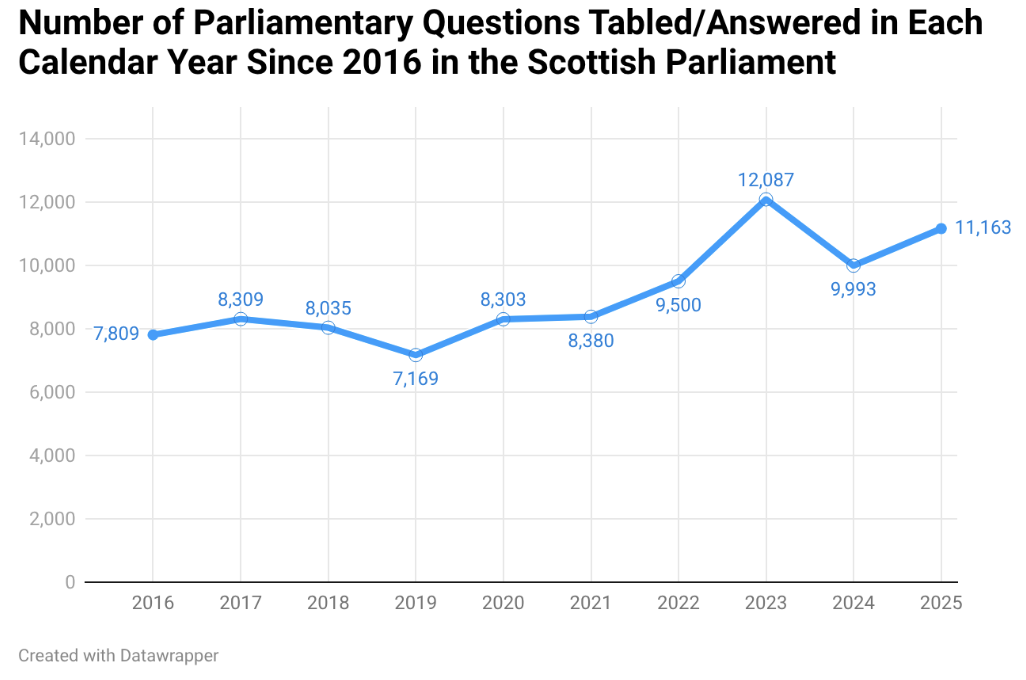
Conversely, Holyrood is yet to witness this trend. Though the number of Parliamentary Questions tabled each calendar year has increased since the last election in 2021, the stark rise seen in Westminster has not been mirrored in Holyrood.
If the data in London reflects Parliament’s upheaval in 2024, in Scotland it is indicative of enduring party dynamics.
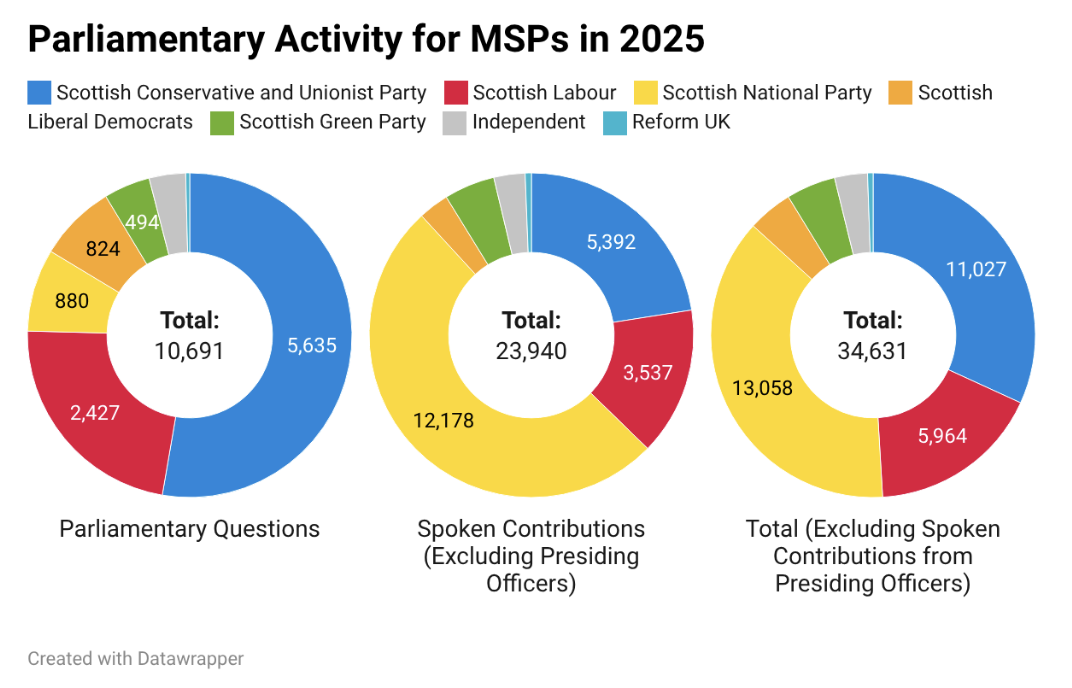
The Scottish Conservatives have been the official opposition in Scotland since 2016, following a sharp decline in support for Labour. Therefore, it should come as little surprise that they asked the most Parliamentary Questions in 2025, accumulating 5,635 out of a total 10,691. In second place; Scottish Labour, who asked 2,427 questions, followed by the SNP in third place with 880.
Proportionally, both the Conservatives and Labour account for a significantly higher share of Parliamentary Questions than their seat share would suggest. The Conservatives asked 53% of all questions tabled in 2025, despite only representing 22% of MSPs, with 12 of their 28 MSPs asking more than 100 Questions across 2025. Labour meanwhile, hold 16% of the seat share and asked 23% of all questions.
Opposition dominance in this regard is to be expected. More than a third of SNP MSPs hold government positions, limiting their role in tabling Parliamentary Questions. Of the MSPs to ask zero questions, 23 of the 24 (the exception being Presiding Officer Alison Johnstone) were SNP Ministers.
There were no SNP MSPs who submitted over 100 Parliamentary Questions in 2025; Kenneth Gibson was their most active, submitting 54 questions in total - the 47th most overall.
However, quite how the Conservatives delivered their Parliamentary Questions is worth noting. Out of their 5,635 questions, 2,678 were submitted by just two individuals: Stephen Kerr and Douglas Lumsden.
Lumsden has attracted significant media and political scrutiny for his use of Parliamentary Questions. In January 2025, he submitted 803 Parliamentary Questions, facing accusations of using AI to “bombard” the Government with questions on frivolous topics. Curiously, Lumsden did not sustain this rapid pace: although he tabled 99 questions in February and 89 in March, he did not table more than 50 throughout the rest of the year.
The tally drew attention to the vast costs Parliamentary Questions can bring, with The National reporting that each question costs £138.07 to answer and three hours and forty minutes of civil servant time, meaning Lumsden’s tranche of questions in January could have cost the taxpayer more than £100,000. Some questions were criticised publicly as offering limited policy value, including queries on the output of the Scottish Parliament’s beehives, further intensifying scrutiny.
Removing the contributions of Kerr and Lumsden, who together tabled more than a quarter of all Parliamentary Questions last year, the rest of the Tory cohort still outperformed their share in Parliament, delivering more than a third of all other questions tabled.
This concentration of Parliamentary Questions is notable given that both Kerr and Lumsden also rank among the Conservative MSPs with the highest number of spoken contributions.
In Kerr’s case, the focus on accountability appears partly rooted in his broader critique of how the Scottish Parliament scrutinises legislation and Ministers. In recent months, Kerr has published a variety of articles and interviews decrying the state of the Scottish Parliament, particularly the lack of scrutiny given to Ministers over legislation and the overly scripted nature of question sessions in the Chamber.
Across the other opposition parties, Parliamentary Questions use is fairly consistent, though with notable diversions in personnel. Five of the ten most active MSPs for Parliamentary Questions were Labour MSPs, including Jackie Baillie - their Deputy Leader. Anas Sarwar is notably absent, having asked just 36. For the Scottish Labour Leader, it appears that impact stems from carefully timed interventions, rather than relentless scrutiny.
This contrasts starkly with Liberal Democrat leader Alex Cole-Hamilton, who asked 301 Parliamentary Questions last year. Cole-Hamilton’s role as the party’s spokesperson on Health, Social Care and Drugs policy requires a more procedural approach to scrutiny, and his questions reflected the need to hone in on specific areas of health policy, as well as the political reality of only having five MSPs to hold the Government to account.
It is in the average number of Parliamentary Questions asked that we can observe their importance for opposition parties to provide scrutiny. Finishing in last place; the SNP with an average of just 15 questions tabled. Conversely, the Scottish Greens’ seven MSPs averaged 71 Parliamentary Questions last year, Labour 116, the Liberal Democrats 165, and the Conservatives 201. Above all, this data demonstrates that, as Scottish politics threatens to undergo a significant restructuring, especially among those holding the Government to account, Parliamentary Questions will mark a key battleground.
Stephen Kerr MSP
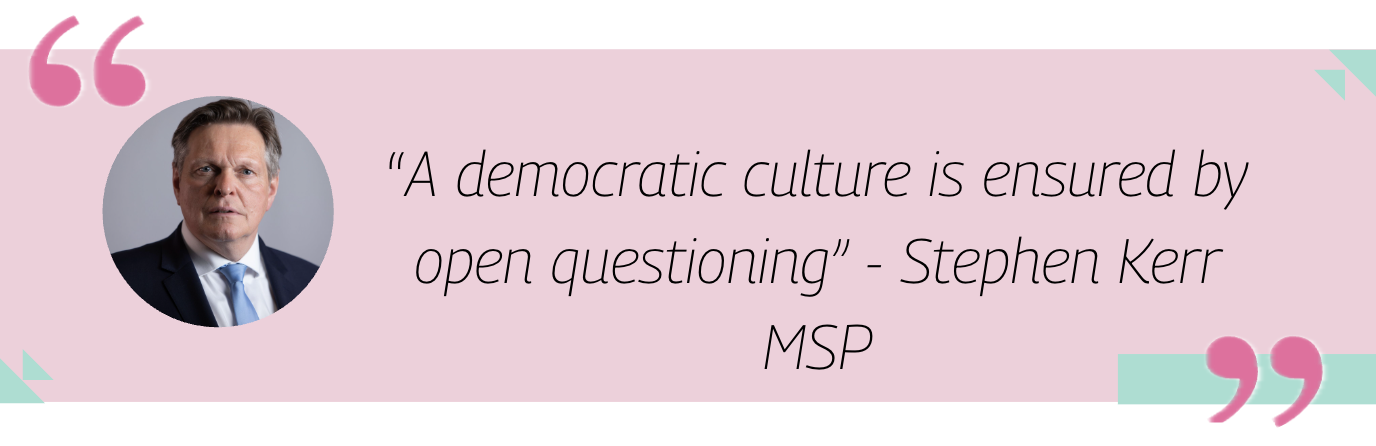
Scrutiny is the job of an MSP, no matter what the party. Parliamentary questions are not simply a way of criticising the government, they are essential to ensuring that taxpayer money is spent appropriately and that public services operate with the highest possible standards. Questions are a way of opening up government and getting that assurance, but perhaps more importantly, a democratic culture is ensured by open questioning. It changes the way that people in Government operate, knowing that the important decisions they are taking and taxpayers money that they are spending may be subject to questions. My approach is to question as much as possible and on as wide a range of subjects as possible. All the questions I and my team have submitted over this term have been pertinent and serious and I hope that they have in some way contributed to the openness and effectiveness of government in Scotland.
Martin Whitfield MSP
“Scrutiny is one of the most important duties of any MSP, particularly after nearly two decades of the same Government. Written Questions and Chamber contributions are essential tools to hold Ministers to account, challenge complacency, and ensure transparency. My approach has always been to use every parliamentary tool available to press the Government where progress has stalled, uncover facts on behalf of constituents, and ensure their voices are heard. This is about standing up for communities across Scotland and making sure the Government delivers on its promises.”
Alex Cole-Hamilton MSP
“I’m actually surprised to have been recognised in this way. I am only doing my job in serving the residents of my community to the best of my ability. It isn’t a chore, it’s a privilege.
Spoken contributions
Across speeches in the Chamber, one pattern is clear: the Government dominates speaking time.
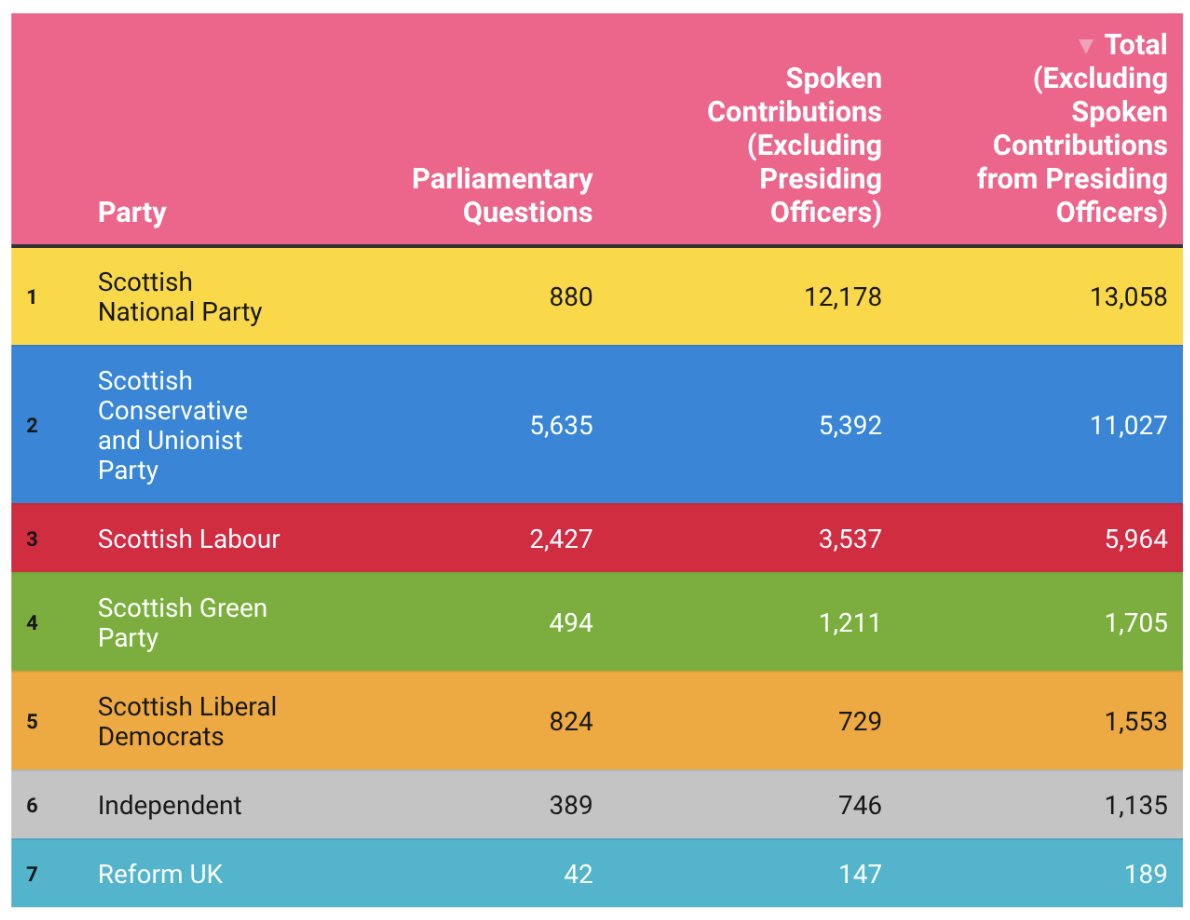
On one hand, this is born from political reality. The SNP controls the Holyrood agenda, and it is their Ministers who answer questions from all parties. As such, it should be no surprise that 51% of speeches made in the Chamber (when excluding Presiding Officers) were delivered by their MSPs.
Most striking is the degree to which speaking time closely mirrored the overall composition of the Parliament. As the table below shows, each party’s contributions closely matched their proportion of seats. This would suggest that, for those looking to articulate their position in the Holyrood chamber following the election, the party makeup is a neat indicator of how frequently voices will be heard.
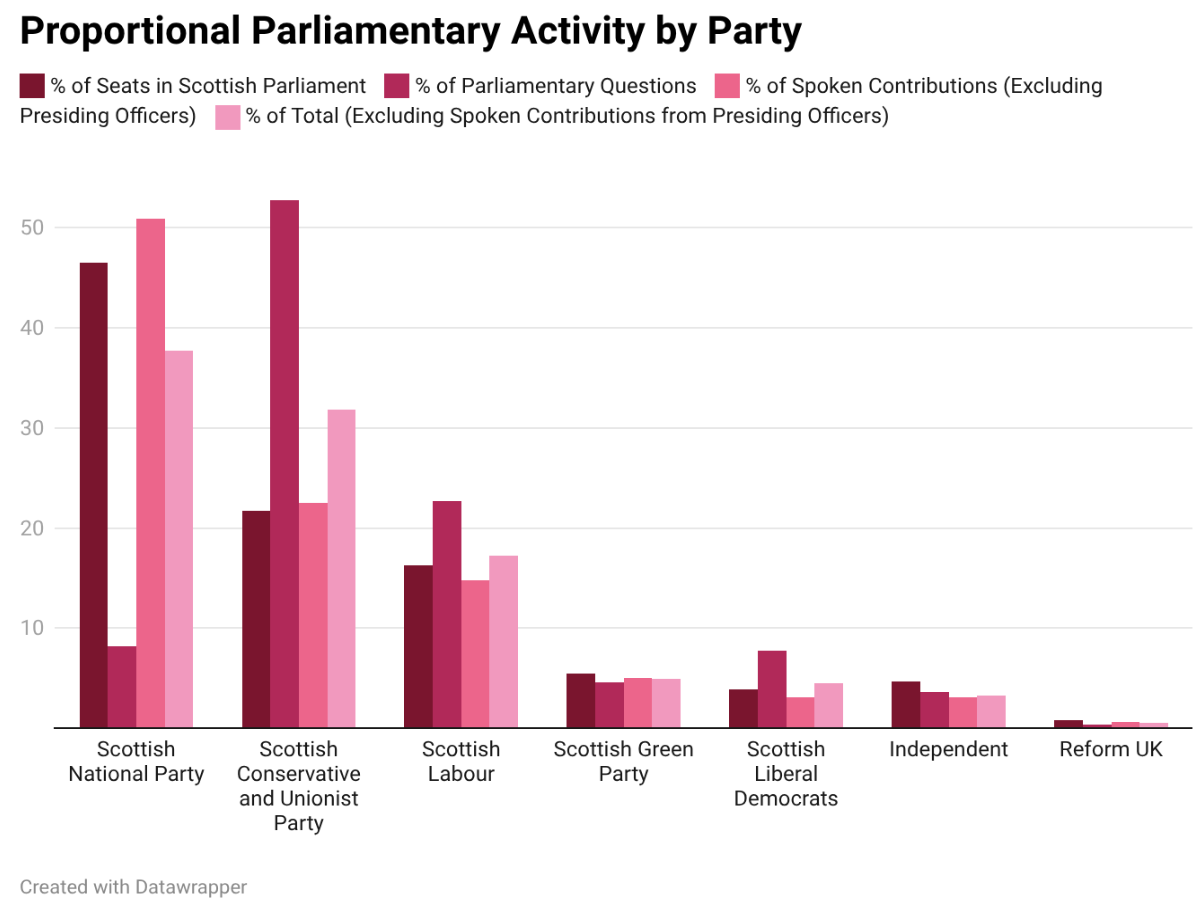
Such a strong alignment with the overall makeup of Holyrood necessitates a greater focus on the individual level, to look at who across government and opposition are making their voices heard.
In this regard, it should come as no surprise that First Minister John Swinney leads all MSPs in spoken contributions by some distance, speaking more than twice as much as the second most active MSP, Cabinet Secretary for Health and Social Care Neil Gray. Swinney’s prominence in the Chamber is largely driven by weekly First Minister's Question Time, which gives him a regular speaking role unmatched by most other Ministers.
Swinney’s dominance in speeches mirrors Westminster. Data from the House of Commons Enquiry Service illustrates that from July 2024 to August 2025, Prime Minister Sir Keir Starmer spoke the third most of any MP in the Commons Chamber. The Prime Minister came after Leader of the House Lucy Powell and DUP MP Jim Shannon respectively. Before the September reshuffle, Powell undertook the mammoth task of Business of the House, while regular watchers of Parliament will know Shannon appears in virtually every debate.
The prevalence of SNP Ministers among the most active speakers reflects their role in Holyrood. Rather than asking Parliamentary Questions to draw out responses, their role is to provide visible accountability and explanation.
Perhaps, then, it shouldn’t be surprising that most scrutinised Ministers are those covering the most significant briefs. Second and third in terms of spoken contributions for the SNP are Neil Gray and Kate Forbes, the Cabinet Secretaries for Health and the Economy respectively.
From the Opposition, two Conservative MSPs were particularly notable: Shadow Minister for Employment and Investment Stephen Kerr and the party’s former leader Douglas Ross.
The extent of Kerr’s activity goes well beyond his brief for employment and investment, with his contributions spanning a range of debates on topics including education and health. So too does the work of Ross who, now without a government role, has shown himself keen to challenge the Government across a range of policy areas.
Westminster observers will find clear similarities in how opposition party leaders operate in Holyrood. Both Russell Findlay and Anas Sarwar confine their speeches in the Chamber to First Minister’s Question Time and debates of particular political significance. As with Parliamentary Questions, less is often more.
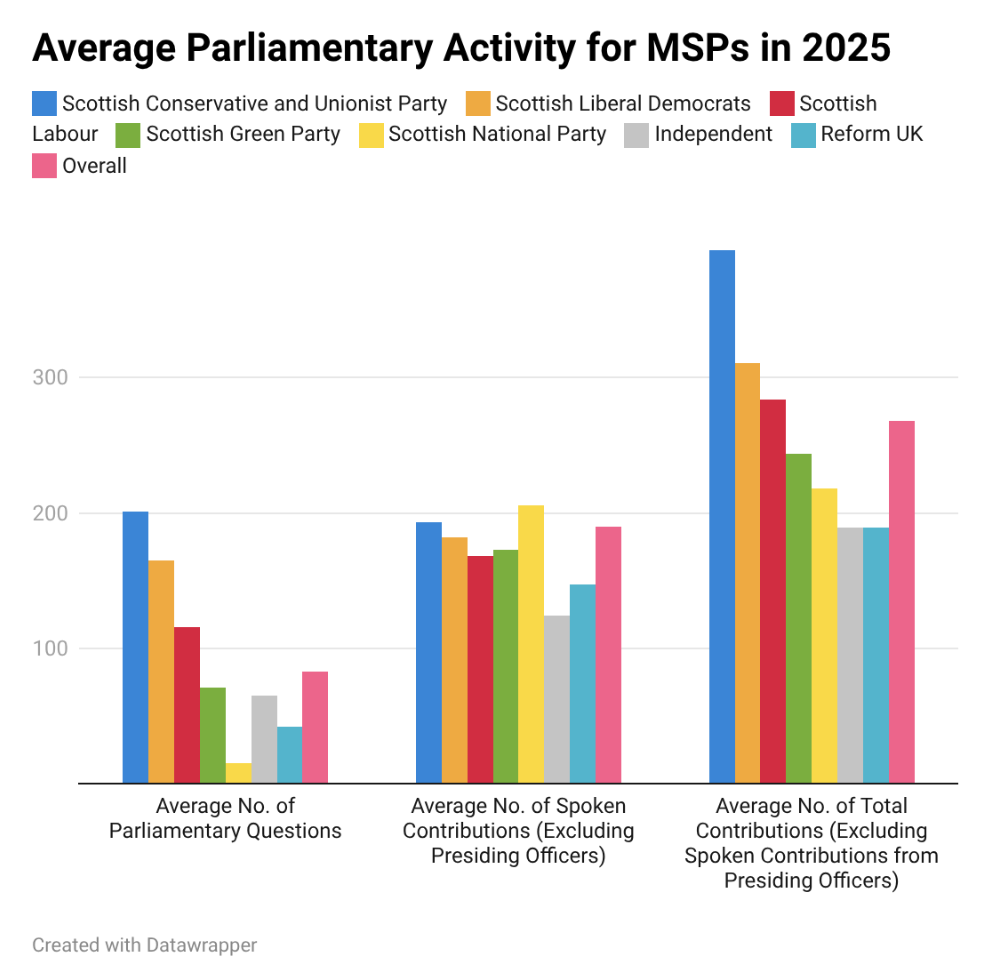
As Holyrood approaches a period of political turnover and likely fragmentation, these patterns of parliamentary activity offer a clearer guide to influence than headline moments alone. Understanding where scrutiny is applied, which MSPs are making their voices heard, and how parliamentary tools are used will be central to navigating Scottish politics after the May elections.
PoliMonitor is expanding its Scottish monitoring to reflect the importance of the upcoming election, with full transcriptions of all proceedings in Holyrood, along with instant alerts for key terms. At the same time, we are constantly updating our CRM with in depth biographies of candidates as they are announced.
Thanks, as always, for using PoliMonitor.